
I became pregnant with my daughter relatively easily. I was 34 when we found out we were expecting. My husband and I had waited about eight years after getting married before trying to conceive. Fast forward four years, and we are now facing secondary infertility.
If you’re unfamiliar, secondary infertility occurs when someone conceives their first child without fertility treatment but struggles to conceive again. It wasn’t something I had ever considered—why would I? I got pregnant within two months and successfully gave birth to my daughter. The idea of now needing medical intervention to have another child has been incredibly difficult to process.
After experiencing a chemical pregnancy, I went to my OB for an ultrasound to check my follicle count. That day, when my doctor told me I had only two follicles on my right ovary and none on my left, our IVF journey began.
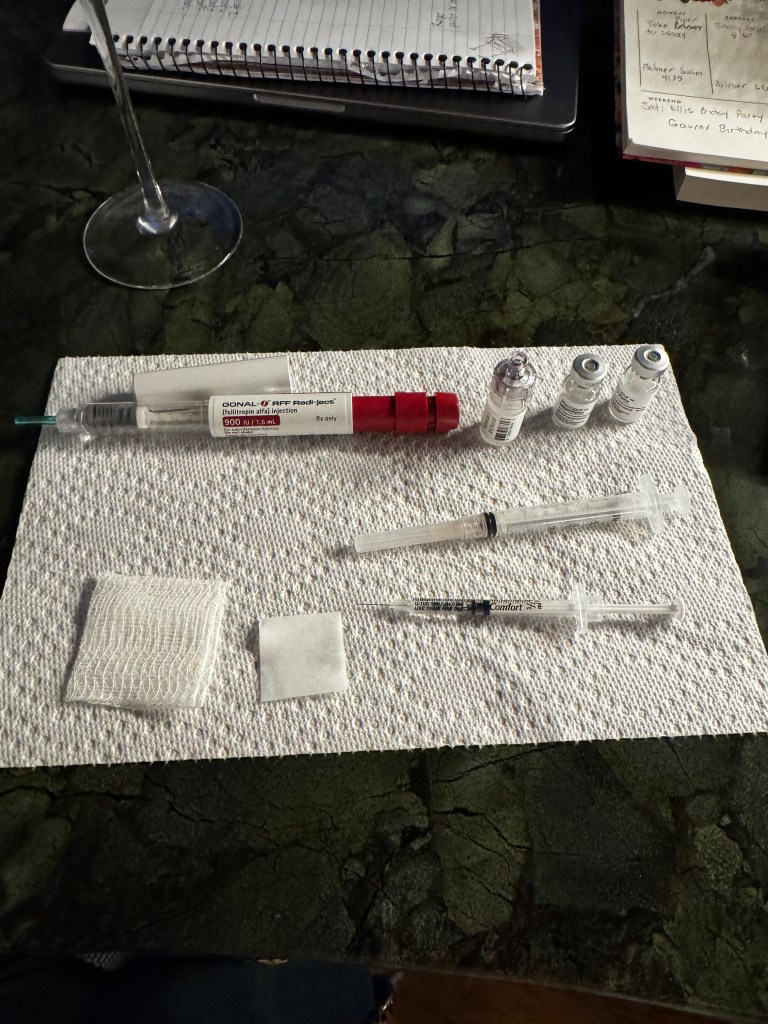
I am grateful to have friends who, unfortunately, know the IVF process all too well. I had no idea how much support I would need—emotionally, physically, and financially. The toll IVF takes is almost indescribable. One of my closest friends warned me that the hardest part is having hope, only to be met with disappointment over and over again. She was right. With every hurdle you clear, there are five more waiting. There are no guarantees in IVF, and with that comes a complete lack of control—two very difficult things to accept.
I was 39 when I started my first IVF cycle—estrogen patches, injections, a mock embryo transfer, and an egg retrieval—only to end up with one embryo that came back chromosomally abnormal. Now, at 40, I’ve just completed my second cycle, with the exact same result. One embryo, not viable.
Waiting for that call from the doctor is gut-wrenching. It’s either a step toward a viable pregnancy or another cycle of injections and procedures. And now, here we are—about to start our final round of IVF, holding onto hope for a better outcome.
Failed IVF cycles bring grief, anxiety, depression, and guilt. After our first failed round, I felt lost. I wasn’t sure how to process the grief of losing an embryo. I remember listening to a podcast about the many ways people grieve during IVF, and it resonated deeply. The loss of a potential life—a little pocket of cells—was more devastating than I had anticipated. I had just put my body through so much, and for what? Nothing.
We had to pause before starting the next round. I needed to give my body a break, and we needed time to recover financially. This last round of IVF was the hardest yet—mentally, physically, and emotionally. The endless procedures, the uncertainty, the complete lack of control—it left me feeling utterly defeated.
It’s an incredibly painful reality to pour so much time, effort, and money into something with no guarantee. And yet, if we are able, we continue. Because even in the darkest moments, hope lingers.
 Momxiety
Leave a comment